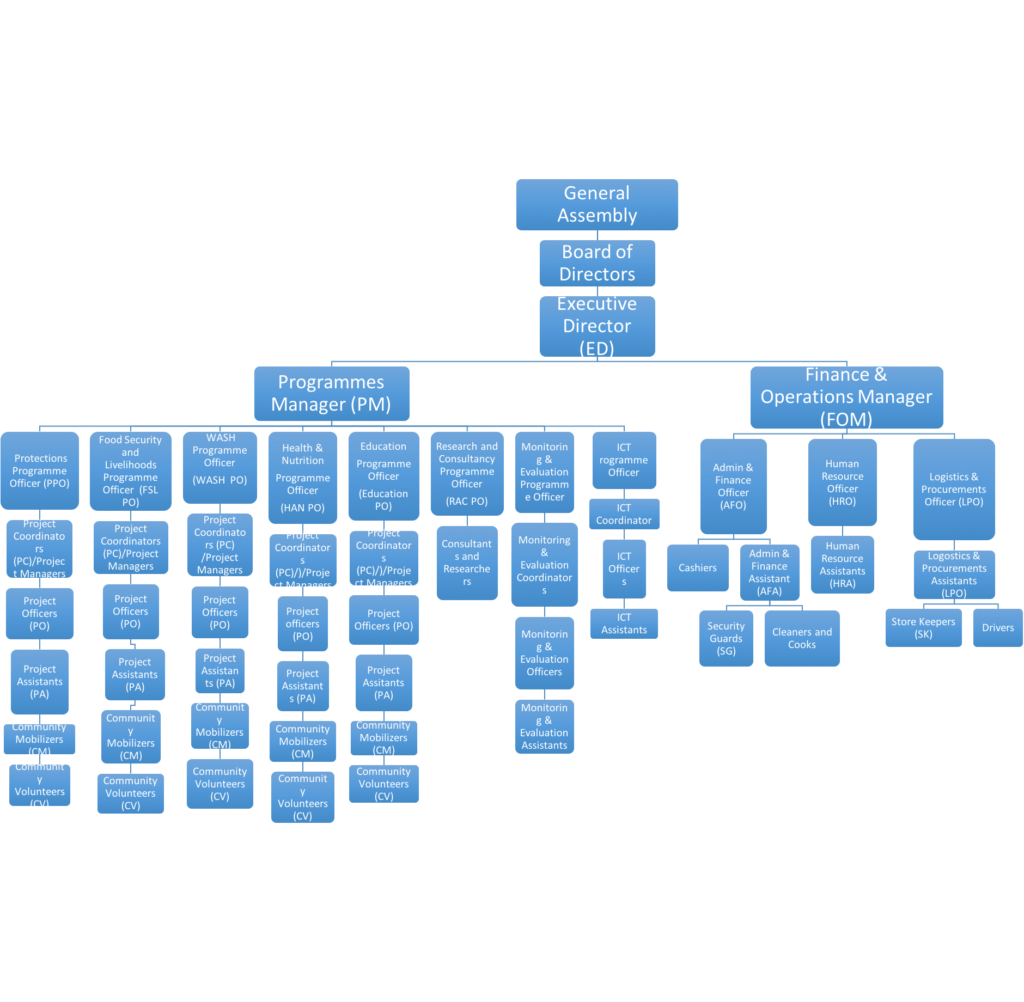
Organizational structure
The Community Initiative for Partnership and Development (CIPAD) operates under a multi-tiered governance and management structure designed to promote transparency, accountability, and community-led action. The structure includes central leadership, oversight bodies, and decentralized field-level offices to ensure effective service delivery, humanitarian response, and advocacy at the grassroots level.
General Assembly
The General Assembly is the supreme governing body of CIPAD. It comprises founding members, ordinary members, honorary members, institutional members, community leaders, and other stakeholders who provide overall strategic direction. The Assembly meets annually to review organizational progress, approve major decisions, and elect members of the Board of Directors.
Board of Directors (BoDs)
The Board of Directors provides governance oversight and strategic policy guidance. It is elected by the General Assembly and is responsible for ensuring that CIPAD remains aligned with its vision, mission, and strategic priorities. The Board approves key documents such as annual budgets, organizational policies, and programmatic plans, while also supervising the performance of the Executive Management Team led by Executive Director.
Executive Management Team (EMT)
The Executive Management Team, led by the Executive Director, is responsible for day-to-day management and implementation of programs and operations. The EMT includes heads of departments such as Programs, Finance, Operations, Human Resources, and MEAL (Monitoring, Evaluation, Accountability & Learning). It ensures that strategic decisions are translated into action and that donor and community expectations are met with professionalism and accountability.
Field-Level Offices
CIPAD maintains field-level offices in targeted areas across South Sudan and other locations, depending on project needs. These offices are managed by Field Coordinators or Project Officers and serve as the frontlines for program delivery, community engagement, data collection, and local coordination. Field teams work closely with local authorities, community structures, and beneficiaries to ensure that services are tailored to local contexts and reach the most vulnerable populations effectively.
This inclusive structure enables CIPAD to function as a community-rooted yet professionally managed national NGO, bridging local needs with national and international partnerships. Registered in 2017 as a national NGO (RRC Reg. No. 902), CIPAD is driven by its founding mission to deliver humanitarian aid, promote sustainable development, and advance peace, protection and inclusion in South Sudan.